
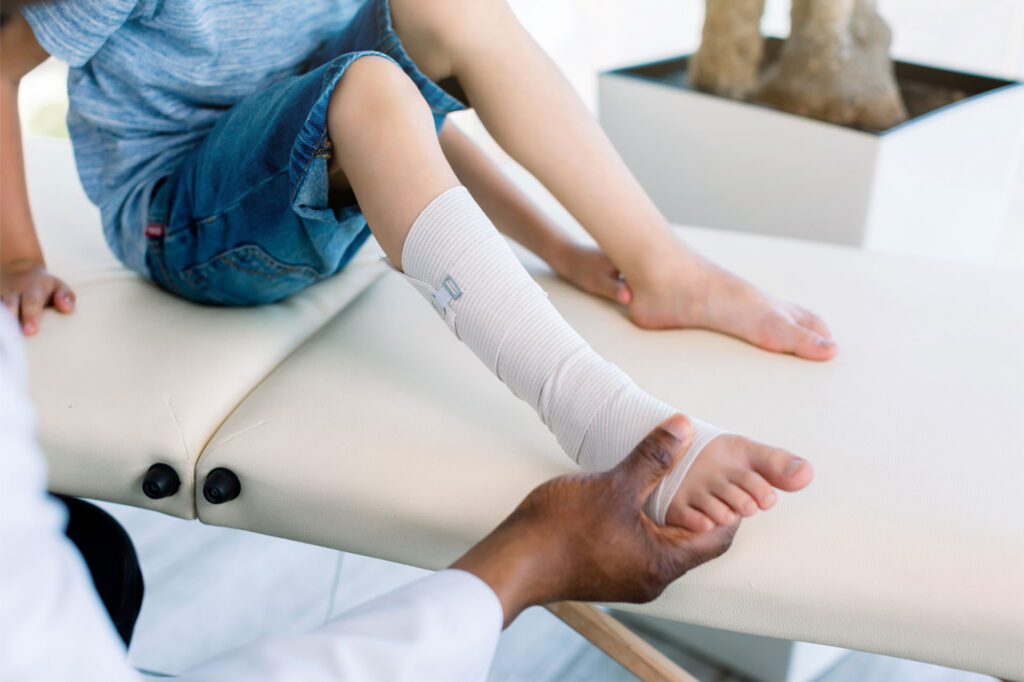
When a child rolls their ankle during a soccer game or a fall on the playground, the first response is usually to assume it is a simple sprain that will heal with rest, ice, and a few days off activity. In many cases, that assumption is reasonable. But in children, an ankle injury that looks and feels like a sprain deserves a closer look than it would in an adult, because the anatomy of a growing child’s ankle means that what appears to be a soft tissue injury may actually involve the growth plate. At POBAR, our pediatric orthopedic specialists evaluate ankle injuries in children with this distinction firmly in mind, because getting it right from the beginning makes a meaningful difference in how well the ankle heals. If your child has twisted their ankle and the symptoms are not resolving as expected, schedule an evaluation today.
The ankle is one of the most commonly injured joints in active children, and it is also one of the most frequently misunderstood when it comes to how pediatric injuries differ from adult ones.
Why Children’s Ankles Are Structurally Different
In adults, the ligaments surrounding a joint are relatively weaker than the bone, which is why adults tend to sprain their ligaments when they twist an ankle. The bone remains intact and the soft tissue takes the damage. In children, this relationship is reversed. The growth plates in a growing child’s bones are composed of cartilage, which is significantly weaker and more vulnerable to injury than the surrounding ligaments. When a child twists their ankle with enough force, the most likely point of failure is the growth plate at the end of the fibula, one of the two bones in the lower leg, rather than the ligaments on the side of the ankle.
This means that many ankle injuries in children that are called sprains are actually fractures through the growth plate. The injury may not look dramatic on the outside. The child may be able to put some weight on the ankle. There may be swelling and bruising that looks similar to a typical sprain. Without a careful physical examination and appropriate imaging interpreted by someone experienced in pediatric orthopedics, a growth plate fracture can be missed and treated as a soft tissue injury, which is an important distinction when it comes to healing and monitoring.
The Problem With Applying Adult Standards to Children
There is a well-known clinical decision tool called the Ottawa Ankle Rules that emergency physicians use to decide whether an adult with an ankle injury needs an X-ray. Research has shown clearly that these rules are not reliably applicable to children, particularly younger children, because the anatomy and injury patterns are fundamentally different. A child who passes the criteria that would rule out fracture in an adult may still have a significant growth plate injury that warrants imaging and orthopedic evaluation.
This is not a criticism of general emergency providers, who appropriately follow evidence-based guidelines. It is simply an explanation for why a child who was seen at urgent care and told they have a sprain may benefit from follow up with a pediatric orthopedic specialist if symptoms persist or if the original evaluation did not include pediatric-specific assessment protocols.
Signs That Suggest More Than a Soft Tissue Sprain
Not every twisted ankle in a child requires immediate specialist referral, but there are specific patterns that suggest the injury may involve more than ligaments. Tenderness directly over the outer portion of the ankle bone rather than just over the ligament in front of or below it is a meaningful sign in a growing child. Significant swelling that develops quickly, inability or strong reluctance to put weight on the ankle, or pain that does not begin to improve within a few days of standard sprain care are all reasons to seek orthopedic evaluation.
It is also worth noting that younger children and adolescents in different stages of skeletal development have different patterns of vulnerability. A young child whose growth plates are still quite active faces different risks than a teenager who is approaching the end of their growth period. At POBAR, the evaluation takes the child’s age and stage of development into account as a fundamental part of assessing the injury.
What Proper Evaluation and Treatment Involve
At POBAR in Brandon, evaluating a child’s ankle injury begins with a careful physical examination that specifically assesses areas of tenderness in relation to the known locations of growth plates and ligaments in a growing ankle. X-rays are interpreted with an understanding of how a child’s developing bones should appear at each stage of growth, and what findings require additional imaging or monitoring. When a growth plate injury is confirmed, the treatment plan is tailored to the type and severity, which may range from a walking boot or cast for several weeks to surgical treatment for injuries where the bone has shifted out of alignment.
True ligament sprains do occur in children, particularly in older adolescents, and they are managed with the same general principles that apply in adult ankle sprains: rest, appropriate support, progressive rehabilitation, and a gradual return to activity when the ankle is stable and pain-free. What differs is the threshold for imaging and specialist involvement, because the cost of missing a growth plate injury in a child is higher than missing one in an adult whose bones are no longer growing.
Active Kids Deserve the Right Start at POBAR
Children who love to run, jump, and compete deserve to have their injuries evaluated by specialists who understand what makes a child’s anatomy unique. At POBAR in Brandon and Riverview, our team is here to make sure that a twisted ankle gets the assessment it actually needs, whether that means reassurance that a true sprain is healing on track or identifying and treating a growth plate injury before it has a chance to affect your child’s development. When something does not seem right after your child’s ankle injury, do not wait. Let us take a closer look.
Frequently Asked Questions
How do I know if my child’s ankle injury is a sprain or a fracture?
In children, this distinction is genuinely difficult to make without a proper examination because growth plate fractures and ligament sprains can look very similar from the outside, which is one of the reasons a pediatric orthopedic evaluation is valuable when an ankle injury in a child does not follow the expected path of improvement. Tenderness directly over the ankle bone rather than over the soft tissue around it, significant swelling, or persistent pain beyond a few days are signs worth having professionally assessed.
Can my child walk on a growth plate fracture?
Yes, some growth plate fractures allow a child to bear partial weight, which is one of the reasons these injuries are sometimes mistaken for sprains. The ability to walk does not rule out a fracture through the growth plate, particularly the fibula, which is the most common location for ankle-related growth plate injuries in children.
Why does my child need to see a pediatric orthopedic specialist for an ankle injury?
Children’s bones are still growing, which means the anatomy and injury patterns in a child’s ankle are fundamentally different from those in an adult, and the clinical tools used to evaluate adult ankle injuries are not always reliable in children. A pediatric orthopedic specialist understands the location and vulnerability of growth plates at each stage of development and can provide an evaluation that is appropriate for your child’s specific age and anatomy.
How long does recovery from a child’s ankle injury take?
Recovery depends on the type of injury, with true ligament sprains in older children often resolving in two to four weeks with appropriate care, while growth plate fractures typically require immobilization for three to six weeks followed by a gradual return to activity under orthopedic guidance. Every child heals differently, and the treatment plan at POBAR is always tailored to the individual child’s injury and development.
Should my child stop all activity after a twisted ankle?
Activity modification is appropriate immediately after an ankle injury until the nature of the injury is understood, and a pediatric orthopedic evaluation can provide clear guidance on what level of activity is safe during recovery. In most cases, the goal is to return your child to full activity as safely and efficiently as possible, with a plan that protects the healing tissue without limiting movement longer than necessary.

Dr. Timothy Bradley, a distinguished member of the Pediatric Orthopedic Society of North America and the American Academy of Orthopedic Surgeons, is a leading expert in pediatric orthopedics serving the community of Brandon, Riverview and whole of Tampa. With a commitment to providing the highest quality care for young patients, Dr. Bradley has earned a reputation for excellence in the field. His expertise and dedication to improving the lives of children through orthopedic solutions make him a trusted authority in the orthopedic community. Dr. Bradley’s
work at POBAR in Tampa exemplifies his passion for compassionate and effective healthcare, ensuring a brighter and healthier future for young patients.